How to Dominate Automotive SEO in 2026: Google Search & AI Optimization
Car buyers are changing how they shop—and if your dealership isn't optimizing for both traditional search and AI-powered discovery, you're losing qualified leads to competitors who are. In 2026, automotive SEO isn't just about ranking for "Ford dealer near me"—it's about being present when shoppers ask ChatGPT which SUV fits three car seats or when they compare models on Gemini before ever opening Google.
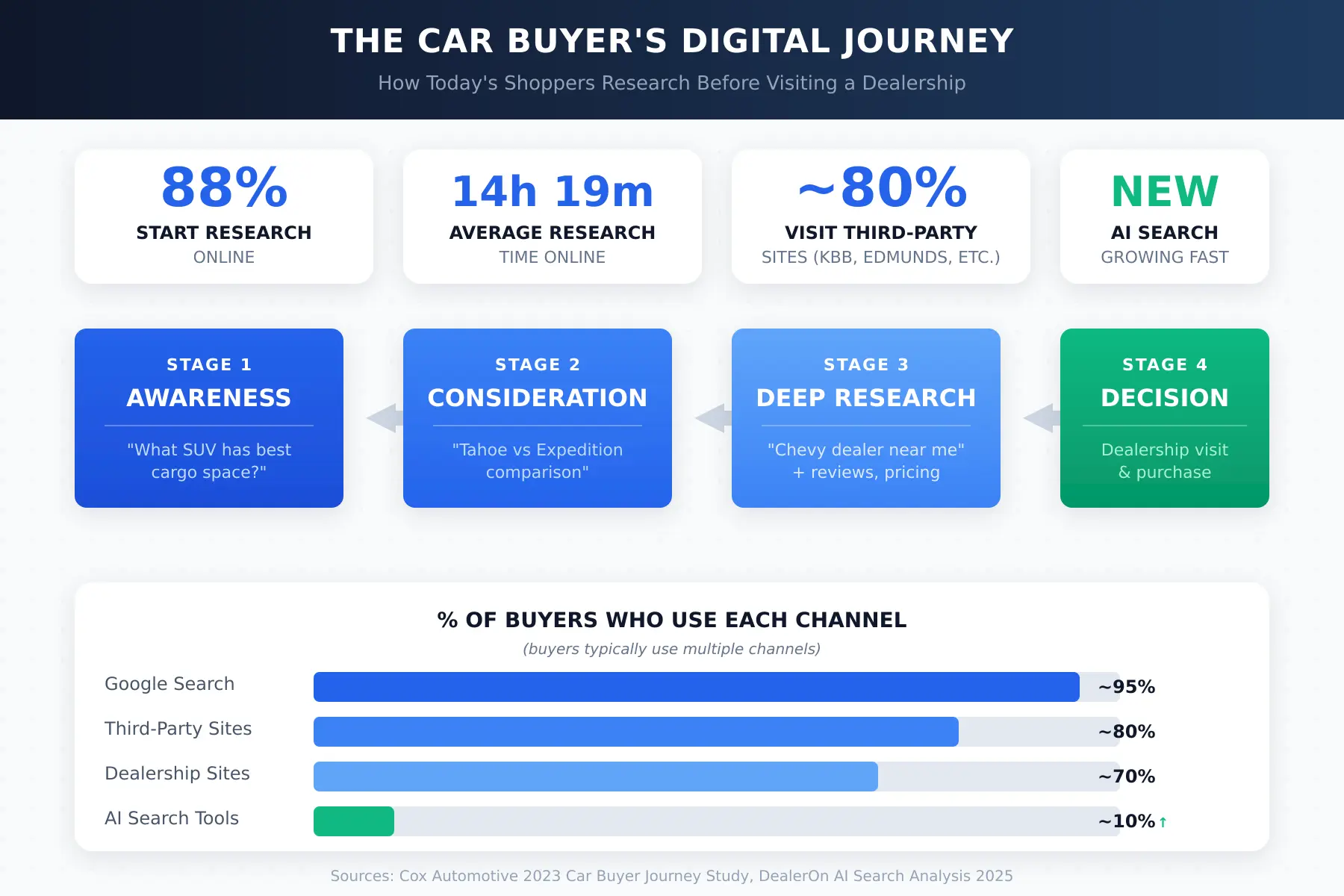
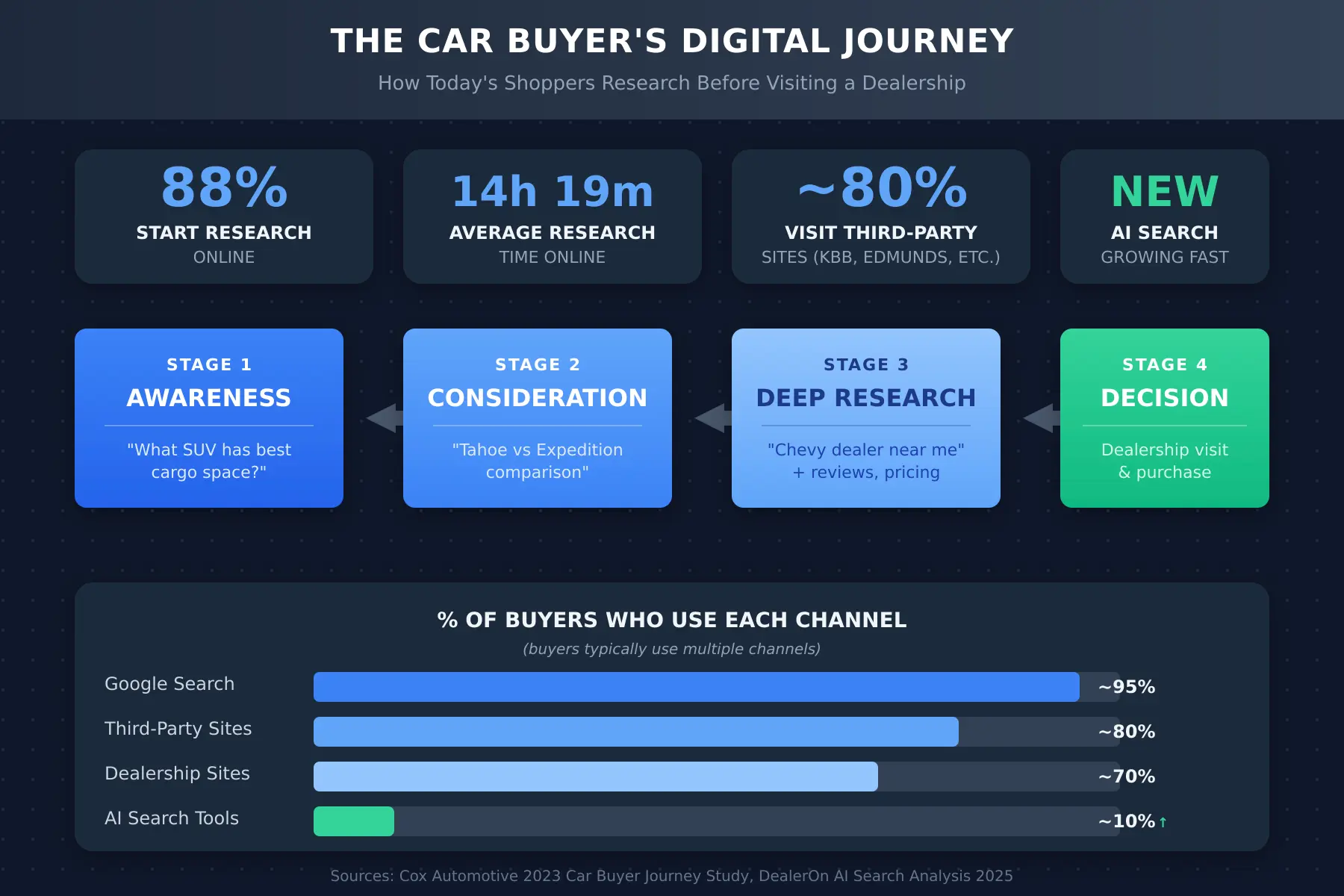
The automotive search landscape has undergone a fundamental shift. While traditional search still drives the majority of dealership traffic, AI search tools are reshaping how buyers begin their journey. Recent industry data shows that over 14 hours of online research precede the average vehicle purchase, and an increasing portion of that research now happens through conversational AI interfaces.
This comprehensive guide provides dealership managers and marketing directors with a complete framework for automotive SEO in 2026—covering both the proven fundamentals that drive immediate results and the emerging AI optimization strategies that build competitive advantage for the future.
The 2026 Automotive Search Landscape: What's Changed
Understanding the current state of automotive search helps frame effective optimization strategies. The core dynamics haven't disappeared—Google still drives the vast majority of dealership website traffic—but the customer journey has expanded to include new discovery channels.
Traditional Search Remains Dominant
Despite the emergence of AI search, traditional search engines continue to account for approximately 95% of automotive website traffic. Shoppers still search for:
• Location-based queries: "Chevrolet dealer near me," "Honda service Indianapolis"
• Inventory searches: "2024 Silverado for sale," "used Accord under $25k"
• Service needs: "brake repair near me," "oil change coupons"
These high-intent, location-specific searches convert at significantly higher rates than broader research queries, making traditional SEO optimization the foundation of any effective automotive digital strategy.
AI Search: Small Traffic, Big Influence
While AI search currently represents a relatively small percentage of direct traffic, its influence on the buyer journey is substantial. According to DealerOn's 2025 research, AI-referred visitors demonstrate measurably different behavior patterns:
Metric | Traditional Search | AI Search Referral |
|---|---|---|
Primary Landing Pages | Homepage, location pages | VDPs, SRPs, research pages |
Visitor Intent | Mixed (research + high intent) | Higher intent, focused |
Conversion Behavior | Standard rates | Elevated conversion rates |
Typical Query Type | "Ford dealer near me" | "Which midsize SUV seats 7?" |
Source: DealerOn AI Search Study, 2025
The key insight: AI search visitors aren't arriving at the beginning of their journey—they're arriving deeper in the funnel, with specific questions already answered and clearer purchase intent. This explains why AI-referred traffic, though smaller in volume, often converts at higher rates than traditional search traffic.
Key Takeaway
Effective automotive SEO in 2026 requires optimization for both channels. Traditional search drives volume and immediate conversions. AI search builds early-stage mindshare and delivers highly qualified traffic. Dealerships that optimize for both gain competitive advantage at every stage of the buyer journey.
Google Business Profile: Your Dealership's Digital Storefront
For most local automotive searches, your Google Business Profile (GBP) appears before your website. It's often the first—and sometimes only—impression potential customers have of your dealership. According to Google's research, complete profiles are 70% more likely to attract location visits and 50% more likely to result in a purchase.
Complete Profile Optimization
Profile completeness directly correlates with visibility in local search results. Every missing field represents lost ranking signals and reduced customer confidence. Essential elements include:
• Accurate NAP (Name, Address, Phone): Inconsistent information across platforms dilutes local ranking signals
• Complete hours: Include holiday hours and special service department hours
• Primary and secondary categories: Choose precise categories like "Car Dealer," "Used Car Dealer," "Auto Repair Shop"
• Service listings: Add specific services (financing, vehicle trade-ins, warranty service) to appear in relevant searches
• Business description: Use natural language that incorporates key terms without keyword stuffing
Visual Content Strategy
Visual content significantly impacts click-through rates and customer trust. Research indicates that profiles with photos receive 35% more clicks than those without.
Strategic photo categories for automotive GBPs:
• Exterior and signage: Professional shots that help customers identify your location
• Showroom and service areas: Clean, well-lit spaces that convey professionalism
• Featured inventory: Highlight popular models and special offers
• Team photos: Humanize your dealership with staff introductions
• Customer areas: Comfortable waiting areas signal customer focus
Update photos quarterly to maintain freshness and reflect seasonal inventory or facility improvements.
Review Management and Response Strategy
Customer reviews influence both search rankings and consumer decisions. BrightLocal's 2024 research found that 98% of consumers read online reviews for local businesses, and 87% say positive reviews influence their decision to use a business.
Effective review management requires:
• Systematic review generation: Request reviews immediately after positive service interactions
• Timely responses: Respond to all reviews within 24-48 hours
• Professional negative review handling: Acknowledge concerns, offer solutions, take conversations offline
• Monitoring and flagging: Flag fraudulent or guideline-violating reviews for removal
Implementation Note
Review velocity matters as much as overall count. A dealership with 200 reviews but none in the past six months signals potential problems. Consistent review generation demonstrates ongoing customer satisfaction and active business operations.
Posts and Q&A Management
Google Posts provide opportunities to highlight current promotions, new inventory, events, and special offers. While their direct SEO impact is modest, they improve engagement and click-through rates by keeping your profile active and informative.
Post strategy recommendations:
• Weekly posts featuring new inventory arrivals
• Monthly service specials and promotional offers
• Event announcements (sales events, community involvement)
• Educational content (maintenance tips, winter preparation guides)
The Q&A section often contains the first questions potential customers have. Proactively populate this section with common questions about financing, trade-ins, service hours, and inventory. This reduces friction in the customer journey and positions your dealership as responsive and transparent.
Building a Strong Local SEO Foundation
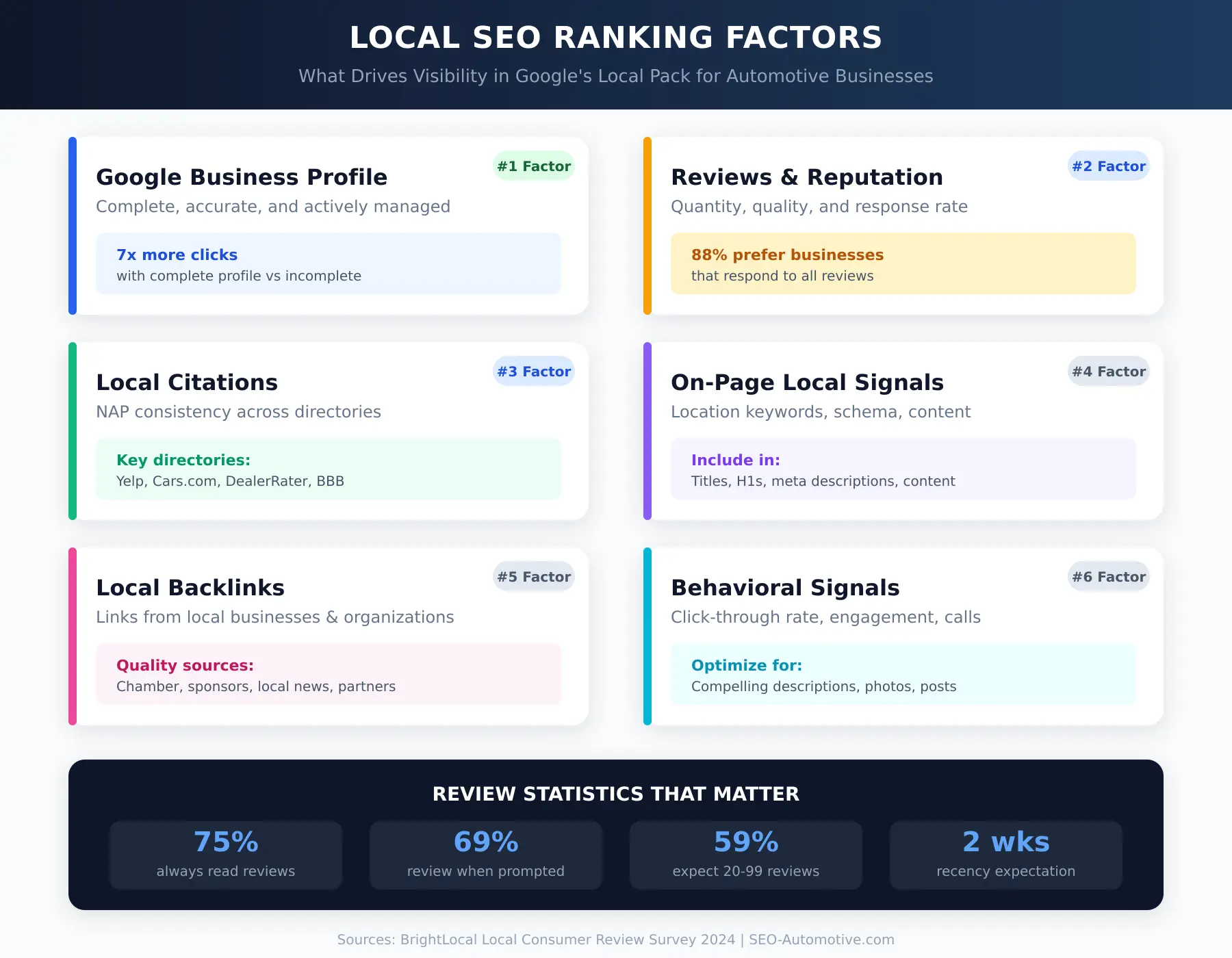
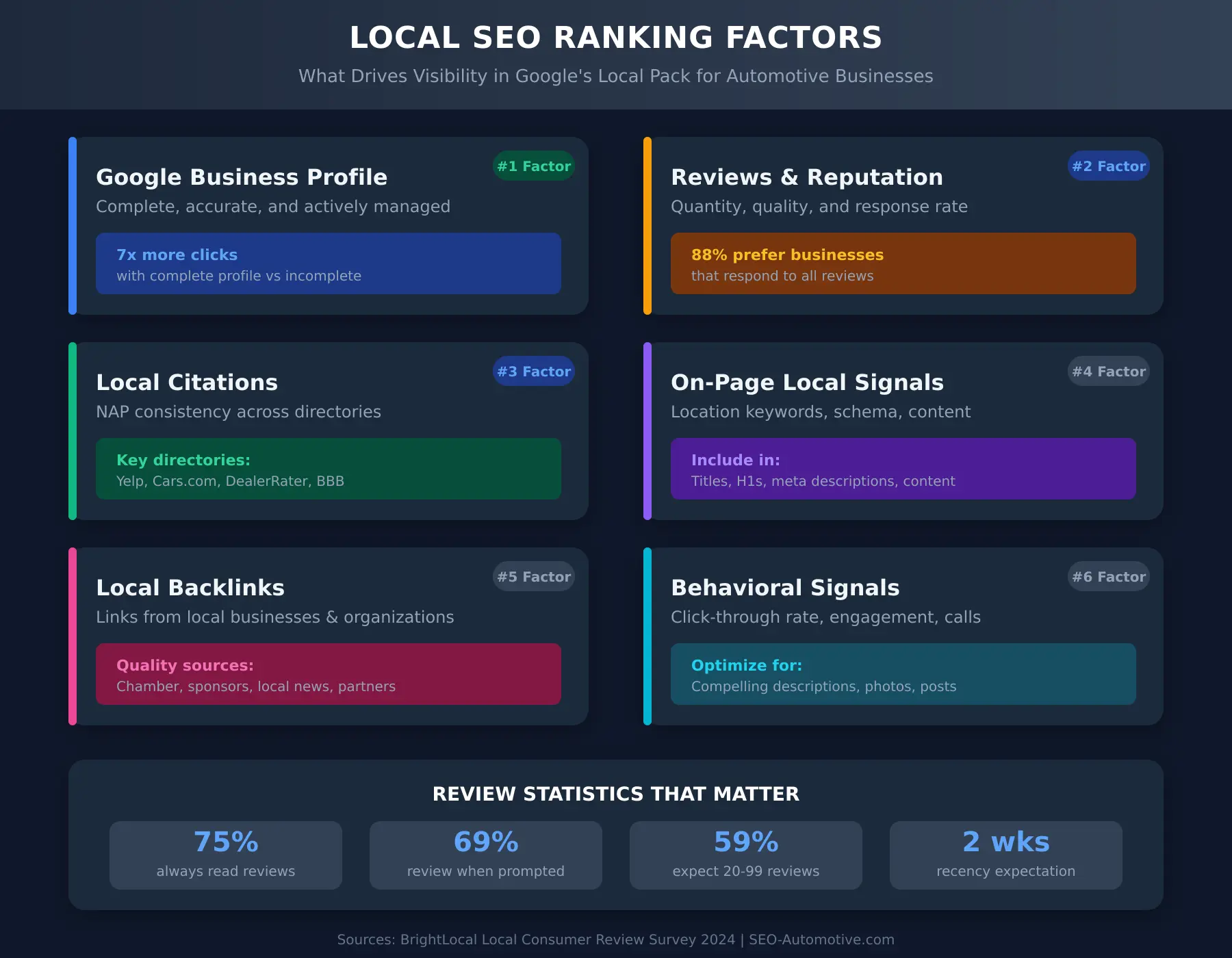
Local SEO extends beyond your Google Business Profile to encompass the entire ecosystem of local search signals. These signals help search engines understand your dealership's relevance, authority, and geographic service area.
Local Citations and Directory Presence
Local citations—mentions of your business name, address, and phone number across the web—serve as validation of your business's legitimacy and location. According to Cox Automotive research, approximately 80% of car buyers visit third-party automotive websites during their research process.
Priority automotive directories and citation sources:
• Cars.com: Major automotive marketplace with high domain authority
• Edmunds: Trusted research platform with comprehensive dealer listings
• CarGurus: Price-focused marketplace popular with value shoppers
• Autotrader: Extensive inventory platform with local dealer focus
• Yelp: Consumer review platform with strong local search presence
• Better Business Bureau: Trust signal for customer service standards
• Foursquare/Apple Maps: Location-based platforms for mobile discovery
NAP Consistency: Non-Negotiable Foundation
Inconsistent business information across platforms confuses both search engines and potential customers. Variations in business name formatting, address abbreviations, or phone numbers dilute the strength of local ranking signals.
Common NAP consistency issues in automotive:
• Business name variations: "Smith Ford" vs. "Smith Ford of Indianapolis" vs. "Smith Ford Dealership"
• Address formatting: "123 Main St." vs. "123 Main Street"
• Suite/building numbers: Inconsistent inclusion of secondary address information
• Phone numbers: Main number vs. service department vs. sales department numbers
Establish a canonical version of your NAP information and use it consistently across all platforms. When moving locations or changing phone numbers, systematically update all citations to maintain signal strength.
Local Keyword Strategy
Local automotive keywords combine service or product terms with geographic modifiers. These searches demonstrate high commercial intent and typically convert at elevated rates.
Keyword Type | Example | Search Intent |
|---|---|---|
Brand + Location | "Toyota dealer Indianapolis" | High intent, location-specific |
Service + Near Me | "Brake repair near me" | Immediate need, local focus |
Inventory + Location | "Used trucks Carmel Indiana" | Shopping, comparing options |
Model + Near Me | "RAV4 dealer near me" | Model-specific, ready to buy |
Incorporate these keyword patterns naturally throughout your website's location pages, service pages, and inventory descriptions. Avoid keyword stuffing—search engines increasingly prioritize natural language and user experience over keyword density.
Technical SEO: Website Performance and Accessibility
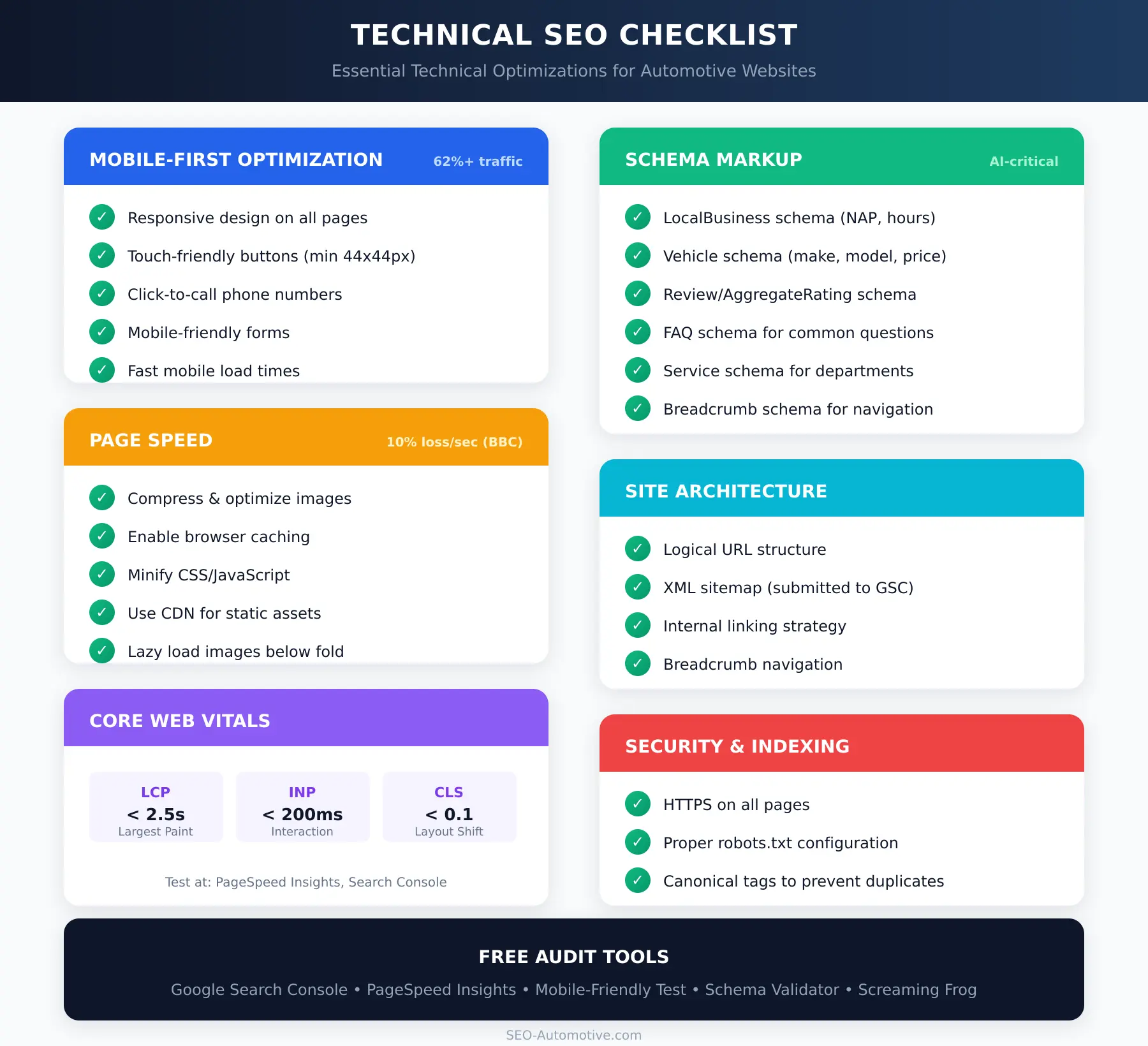
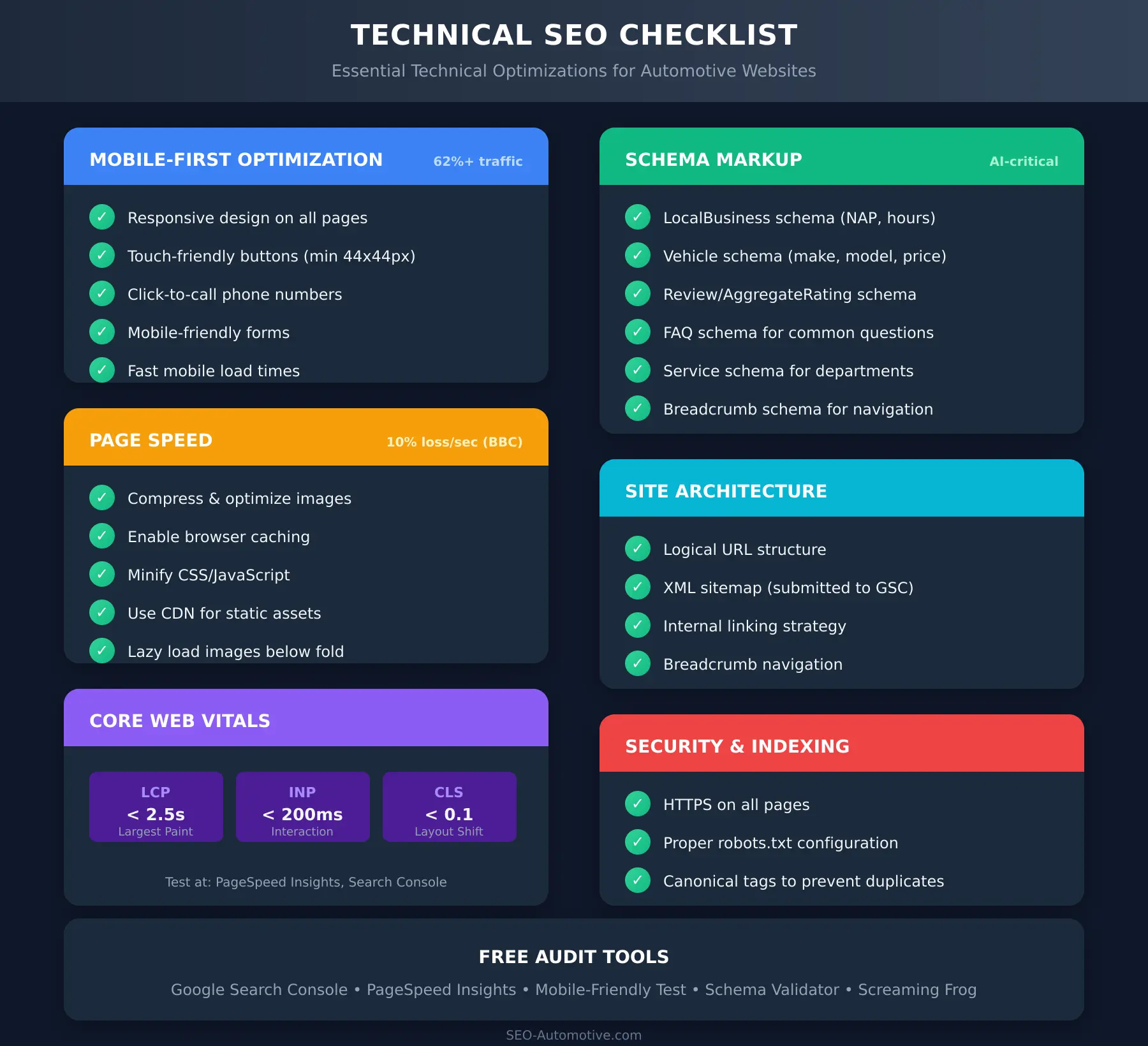
Technical SEO ensures search engines can efficiently crawl, index, and understand your website while providing users with fast, accessible experiences. In automotive, where shoppers frequently browse inventory on mobile devices, technical performance directly impacts both rankings and conversion rates.
Core Web Vitals and Page Speed
Page speed affects both user experience and search rankings. Google's research indicates that as page load time increases from 1 to 3 seconds, bounce probability increases by 32%. For inventory-heavy automotive sites, speed optimization is particularly critical.
Core Web Vitals metrics focus on:
• Largest Contentful Paint (LCP): Measures loading performance (target: under 2.5 seconds)
• First Input Delay (FID): Measures interactivity (target: under 100 milliseconds)
• Cumulative Layout Shift (CLS): Measures visual stability (target: under 0.1)
Common performance issues in automotive websites:
• Unoptimized vehicle images: High-resolution photos without compression
• Multiple third-party scripts: Chat widgets, analytics, inventory feeds loading synchronously
• Render-blocking resources: CSS and JavaScript preventing initial page display
• Server response times: Slow hosting or database queries affecting dynamic pages
Use Google PageSpeed Insights to audit your site's performance and identify specific optimization opportunities. The tool provides both mobile and desktop assessments along with actionable recommendations.
Mobile-First Optimization
Google's mobile-first indexing means your mobile site version determines your search rankings. With over 60% of web traffic originating from mobile devices, mobile optimization isn't optional—it's foundational.
Mobile optimization priorities for automotive sites:
• Responsive design: Layouts that adapt seamlessly across screen sizes
• Touch-friendly interfaces: Buttons and links sized appropriately for touch targets (minimum 48x48 pixels)
• Streamlined navigation: Simplified menus that work on small screens
• Click-to-call functionality: Phone numbers formatted as clickable links
• Location access: Map integration and directions functionality
Test your mobile experience regularly using real devices, not just desktop browser simulators. Pay particular attention to inventory browsing, filter functionality, and form completion—these are the high-value interactions that drive conversions.
Managing Popups and Interstitials
Aggressive popups damage user experience and can trigger ranking penalties under Google's intrusive interstitial guidelines. Automotive sites often deploy multiple overlays (chat widgets, email capture, special offers), creating frustrating experiences that increase bounce rates.
Best practices for dealership overlays:
• Delay display: Allow visitors 15-30 seconds to engage with content before showing overlays
• Limit frequency: Show only one overlay per visit, not multiple sequential interruptions
• Easy dismissal: Clear, accessible close buttons (avoid deceptive or hard-to-find exit methods)
• Mobile sensitivity: Reduce or eliminate popups on mobile where screen space is limited
• Value-focused messaging: Offer genuine value (special pricing, exclusive inventory) not generic email signup requests
If conversion rate from overlays doesn't offset the increased bounce rate they create, consider less intrusive alternatives like sticky headers, slide-in boxes, or exit-intent overlays.
Optimizing Vehicle Listings for Search and Conversion
Vehicle Detail Pages (VDPs) and Search Results Pages (SRPs) represent your highest-value pages for both traditional and AI search. These pages directly connect searcher intent with available inventory, making optimization critical for both visibility and conversion.
Beyond OEM Descriptions: Creating Unique Content
Manufacturer-provided descriptions create duplicate content issues when used verbatim. Hundreds or thousands of dealerships use identical descriptions, diluting the uniqueness signals search engines prioritize. More importantly, generic OEM content fails to address local buyer concerns or highlight dealership-specific value propositions.
Effective vehicle description strategy:
• Rewrite OEM copy: Use manufacturer information as reference but create original descriptions
• Highlight condition and features: Call out recent service, upgrades, or standout equipment
• Address local context: Reference weather conditions, commuting patterns, or lifestyle fit
• Include natural keywords: Integrate search terms conversationally without forced repetition
• Write for buyers, not search engines: Conversational tone that addresses real purchase considerations
Scaling Unique Descriptions
For dealerships with hundreds of vehicles, creating fully unique descriptions for every listing may not be feasible. Focus unique content on your highest-value inventory (newest arrivals, best-sellers, certified pre-owned) and use template variations with unique elements for remaining inventory. This balances SEO value with operational efficiency.
Schema Markup: Making Your Listings Stand Out
Structured data (schema markup) helps search engines understand vehicle listings and enables rich results that increase click-through rates. Rich results display additional information—price, mileage, condition—directly in search results, making your listings more visible and informative.
Essential schema types for automotive:
• Vehicle Schema: Year, make, model, VIN, mileage, price, condition, body type
• Offer Schema: Pricing information, special financing, lease details
• Review Schema: Customer ratings and reviews at the vehicle or dealership level
• Organization Schema: Dealership information, contact details, social profiles
Implement schema markup through your website platform or inventory management system. After implementation, validate your structured data using Google's Rich Results Test to ensure proper formatting and eligibility for enhanced search display.
Internal Linking Strategy
Internal links connect related content, distribute page authority, and help search engines understand site structure. Strategic internal linking keeps visitors engaged longer and increases the likelihood of conversion by surfacing relevant inventory and information.
Effective internal linking for automotive sites:
• Related inventory: Link similar vehicles (same model, price range, body style)
• Blog to inventory: Connect content marketing pieces to relevant vehicle listings
• Service to sales: Link service pages to vehicle lines known for reliability
• Financing to inventory: Connect financial services pages to inventory filtered by price
• Model research to available units: Link comparison guides to in-stock vehicles
Avoid orphaned pages—pages with no internal links pointing to them. Regularly audit your site structure to ensure all important pages are accessible through internal navigation and contextual links.
Optimizing for AI Search Discovery
AI search represents the future of automotive discovery. While traffic volumes remain modest, early optimization positions dealerships to capture market share as adoption accelerates. The good news: AI optimization largely builds on traditional SEO fundamentals rather than requiring entirely new strategies.
Understanding AIO, GEO, and Their Relationship to SEO
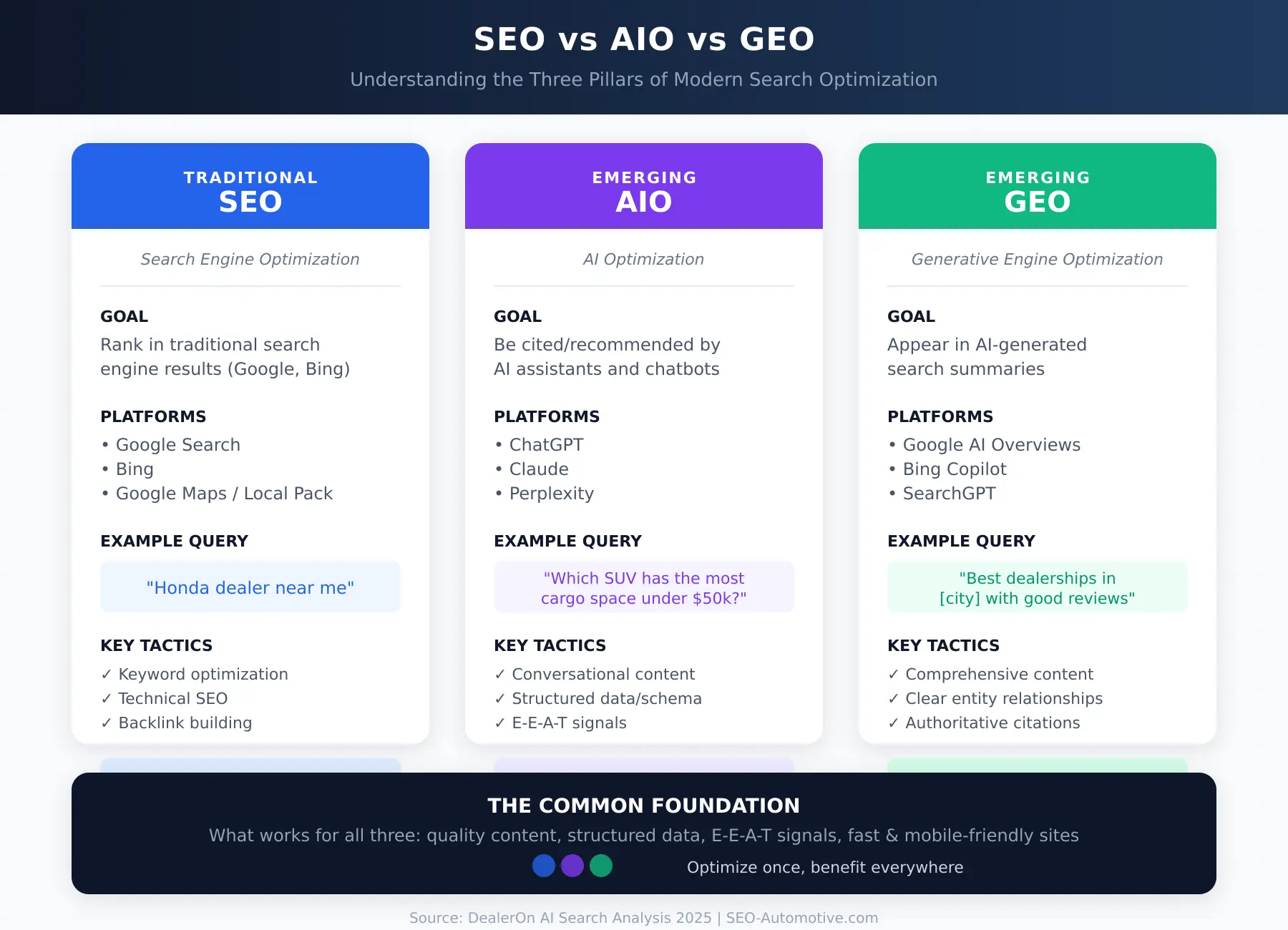
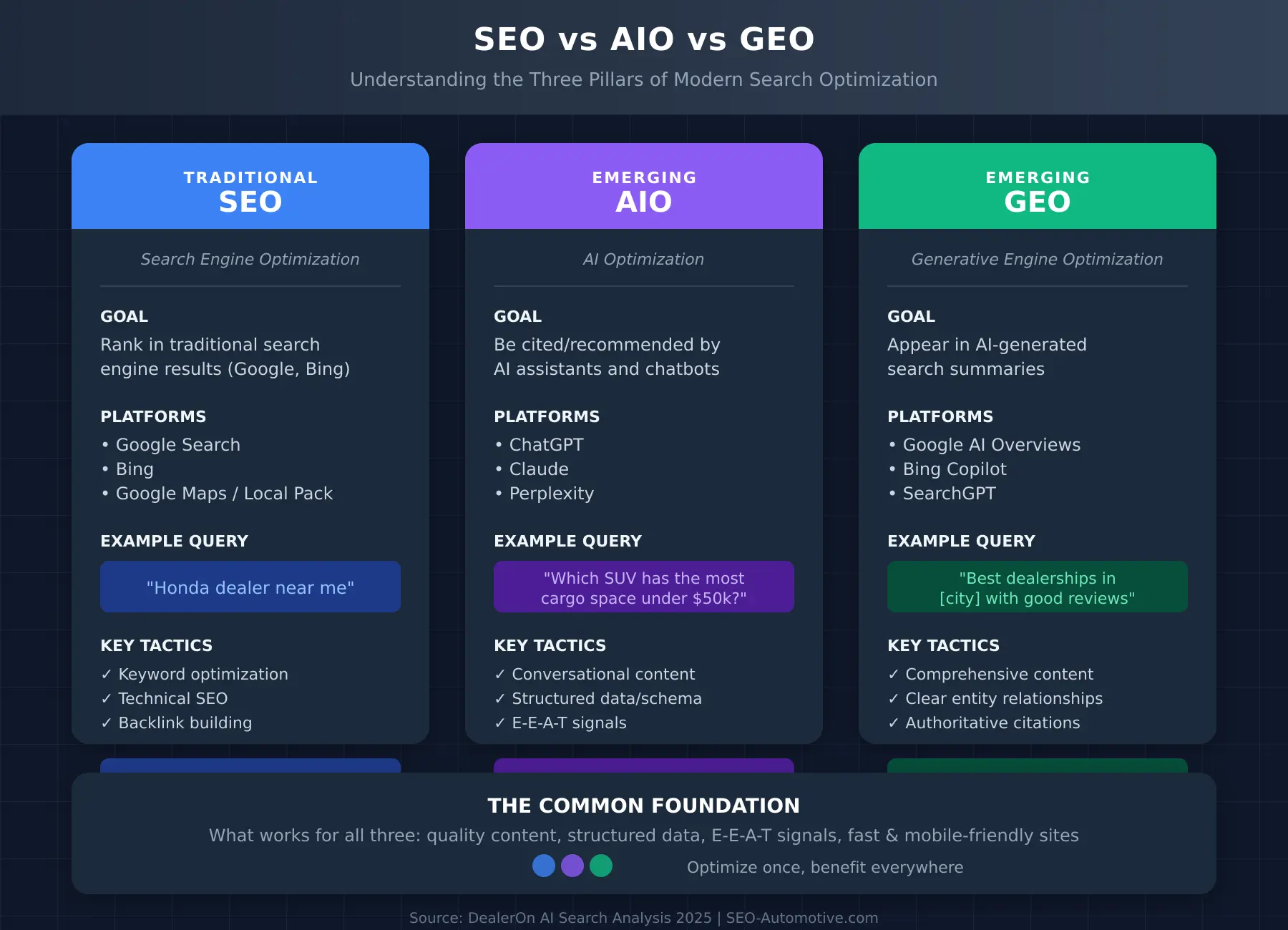
The proliferation of acronyms—AIO (AI Optimization), GEO (Generative Engine Optimization)—can create confusion. In practice, these represent extensions of established SEO principles applied to new discovery channels.
Optimization Type | Focus Area | Dealership Application |
|---|---|---|
SEO | Traditional search ranking | Ranking for "Honda dealer near me," inventory pages |
AIO | AI assistant recommendations | Being cited when users ask ChatGPT vehicle questions |
GEO | Generative search summaries | Appearing in AI-generated search result summaries |
Source: DealerOn AI Search Analysis, 2025
The critical insight: these aren't separate strategies. The content, structure, and authority signals that perform well in traditional search also perform well in AI-powered discovery. The primary difference lies in how AI tools interpret and present information.
What AI Tools Look For
According to DealerOn's research, AI search tools primarily surface three types of dealership pages:
• Vehicle Detail Pages and Search Results Pages: Structured inventory with clear specifications
• About/Why Buy pages: Dealership context, values, and differentiation
• Model research and comparison content: Educational resources that answer buyer questions
AI tools favor these pages because they contain structured information (through schema markup), answer specific questions, and provide contextual information that helps AI understand relevance and authority.
Conversational Content That Answers Real Questions
AI search queries differ fundamentally from traditional keyword searches. Instead of typing "best family SUV," users ask "Which SUV has the most cargo space and three-row seating under $40,000?" Your content needs to address these natural language queries directly.
Content optimization strategies for AI discovery:
• Question-based headers: Use actual customer questions as section headers
• Direct, concise answers: Provide clear responses early in content, then elaborate
• Natural language: Write as if speaking to a customer, not a search engine
• Comprehensive coverage: Address related questions users might ask next
• Fresh information: Regularly update content to reflect current inventory and incentives
Common customer questions to address in content:
• "What's the best truck for towing?" (Comparison content)
• "Which hybrid gets the best gas mileage?" (Specification-based answers)
• "What SUV fits three car seats comfortably?" (Practical use cases)
• "How much should I expect to pay for [model]?" (Pricing guidance)
• "What's the difference between [trim A] and [trim B]?" (Feature comparison)
The Importance of About/Why Buy Content
Many dealerships neglect their About Us, Why Buy From Us, and team introduction pages. These pages become significantly more valuable in AI search because they provide contextual information AI tools use to understand dealership positioning and differentiation.
Optimize these pages by:
• Articulating unique value: Specific differentiators beyond generic "best service" claims
• Including team expertise: Certifications, experience, community involvement
• Highlighting customer commitments: Warranties, guarantees, transparent pricing practices
• Updating regularly: Keep content current with recent achievements and changes
When AI tools recommend dealerships, they often reference information from these pages to explain why a particular dealership might be a good fit. Stale or generic content misses this opportunity.
Implementation Priority
AI optimization doesn't require abandoning proven SEO strategies. Focus first on traditional SEO fundamentals—they drive immediate results and establish the foundation AI tools use. Layer AI-specific optimizations (conversational content, updated About pages, comprehensive FAQ sections) progressively over time.
Content Marketing Strategy That Drives Qualified Traffic
Content marketing addresses the reality that buyers spend 14+ hours researching before making purchase decisions. Dealerships that provide valuable information during this research phase build awareness, establish authority, and position themselves favorably when buyers are ready to transact.
Keyword Research for Automotive Content
Effective content starts with understanding what questions your potential customers are asking. Keyword research tools like Ahrefs, SEMrush, or Google's Keyword Planner reveal search volume and competition for specific terms.
Focus your research on:
• Local modifiers: Include your city/region to identify location-specific opportunities
• Commercial intent keywords: Terms indicating purchase readiness ("best price," "deals," "financing")
• Question-based searches: "How," "what," "which," "should I" queries
• Model comparisons: "[Model A] vs [Model B]" searches
• Maintenance and service: "how often," "cost of," "what does [service] include"
Evaluate keywords on three dimensions: search volume (demand), keyword difficulty (competition), and search intent (user goal). Prioritize keywords with moderate volume, manageable difficulty, and clear commercial or navigational intent.
High-Value Content Types for Automotive
Certain content formats consistently perform well for automotive dealerships because they align with how buyers research and make decisions.
Vehicle Comparisons
Comparison content addresses the natural shopping behavior of evaluating multiple options. Buyers want to understand differences in features, pricing, performance, and value.
Effective comparison structure:
• Side-by-side specification tables
• Clear advantages and disadvantages of each option
• Use-case recommendations ("best for families," "best for commuters")
• Links to available inventory for compared models
Buying Guides
First-time buyers and those unfamiliar with the automotive purchase process benefit from educational guides that demystify the experience.
Valuable guide topics:
• "How to Buy a Car: Complete Guide for [Your City]"
• "New vs. Used: Which Makes More Sense for Your Budget?"
• "Understanding Auto Financing: Terms You Need to Know"
• "What to Know Before Trading In Your Vehicle"
Service and Maintenance Content
Service content attracts vehicle owners beyond your customer base and establishes your service department as authoritative and trustworthy.
Service content opportunities:
• Maintenance schedules by model and mileage
• Seasonal preparation guides (winter tires, summer cooling system checks)
• "Warning signs" content (brake problems, transmission issues)
• Cost guides for common repairs and services
Measuring Content Performance
Track content marketing effectiveness through both traffic and conversion metrics. Use Google Analytics 4 to monitor:
• Organic traffic to content pages: Are people finding your content?
• Engagement rate: Are visitors reading and interacting with content?
• Conversion paths: Does content lead to inventory views, form fills, or calls?
• Assisted conversions: Content that appears in conversion paths, even if not last-click
Content marketing typically shows results over months, not weeks. Focus on building a library of evergreen content that continues attracting traffic long after publication.
Fixed Operations SEO: The Underutilized Profit Center
Most dealerships focus SEO efforts exclusively on vehicle sales, overlooking the substantial opportunity in service and parts visibility. Service searches often indicate immediate need and local intent—exactly the combination that drives high-conversion traffic.
Why Service SEO Matters
Service customers represent recurring revenue opportunities. Unlike vehicle sales, service needs recur regularly and aren't limited to your current customer base. Effective service SEO attracts customers from competitors and independent shops.
Service search characteristics:
• High local intent: "Near me" searches dominate service queries
• Immediate need: Service searches often indicate urgent problems requiring quick solutions
• Lower competition: Many dealerships don't optimize service content
• Cross-sell opportunities: Service customers become vehicle sales prospects
Individual Service Page Strategy
Create dedicated pages for each service offering rather than listing everything on a single "Service" page. Individual pages allow you to target specific search queries and provide detailed, relevant information.
Essential service pages:
• Oil Change Service
• Brake Repair and Replacement
• Tire Service and Replacement
• Battery Testing and Replacement
• Transmission Service
• Engine Diagnostics
• Air Conditioning Service
• State Inspections
Each service page should include:
• Clear service description: What's included, how long it takes
• Pricing guidance: Starting prices or price ranges (transparency builds trust)
• Warning signs: When customers should seek this service
• Appointment scheduling: Clear CTA with online booking or phone number
• Local keywords: City/neighborhood names naturally incorporated
FAQ Content for Voice Search and Featured Snippets
FAQ sections serve multiple purposes: they address common customer concerns, target long-tail keywords, and position content for featured snippets in search results. Voice searches, which continue growing, often trigger FAQ-style content.
Effective FAQ topics for service pages:
• "How much does [service] cost?"
• "How often should I [service]?"
• "What are signs I need [service]?"
• "Do you offer [specific warranty/guarantee]?"
• "Can I wait while my car is serviced?"
Structure FAQ answers with direct, concise responses in the first 1-2 sentences, then provide additional detail. This format works well for both voice search results and featured snippets.
Local Link Building: Earning Authority Through Partnerships
Backlinks—links from other websites to yours—remain a core ranking factor. For local automotive businesses, high-quality local backlinks provide both SEO value and referral traffic from relevant audiences.
Quality Over Quantity
Not all backlinks carry equal value. A single link from a respected local news site or industry authority carries more weight than dozens of low-quality directory listings. Focus your link building efforts on acquiring links that provide genuine value.
High-value link characteristics:
• Relevance: Links from automotive or local business websites
• Authority: Established websites with their own strong backlink profiles
• Geographic proximity: Local websites serving your market area
• Natural context: Editorial links within relevant content, not paid directory listings
Strategic Local Partnership Opportunities
The most sustainable link building comes from genuine business relationships that create mutual value. Consider partnerships with complementary local businesses:
Automotive Service Ecosystem
• Independent mechanics: Establish referral relationships for repairs outside their scope
• Auto parts retailers: Create content partnerships or sponsor local store events
• Body shops and detailers: Mutual referral programs with website acknowledgment
• Driving schools: Natural fit for first-car buyers, often need financing guidance
Financial Services Partners
• Local banks and credit unions: Joint educational content on auto financing
• Insurance agencies: New vehicle insurance requirements, discount programs
Community Organizations
• Chamber of Commerce: Member directories and event sponsorships
• Local charities and nonprofits: Vehicle donation programs, event sponsorships
• Sports teams and schools: Sponsorship recognition on organization websites
Local Media and PR Opportunities
Local news outlets, business journals, and community publications provide high-authority backlinks when you become a newsworthy story. Create opportunities through:
• Community involvement: Significant charitable contributions or employee volunteer programs
• Industry expertise: Provide commentary on automotive trends for local business coverage
• Event hosting: Car shows, safety demonstrations, or financial literacy workshops
• Unusual inventory: Rare vehicles or unique trade-ins can generate media interest
Customer Testimonial Backlinks
If you serve local businesses (fleet sales, company vehicles), request testimonials on their websites with links back to your dealership. Business customers often maintain websites and are willing to recognize excellent vendor relationships.
Links to Avoid
Stay away from link schemes, paid links without proper disclosure, and low-quality directory spam. These tactics risk manual penalties from Google and provide minimal ranking value. Focus on earning links through genuine relationships and valuable content.
Evaluating Automotive SEO Vendors and Avoiding Common Pitfalls
Not all SEO services deliver equivalent value. The automotive SEO industry includes both highly skilled specialists and vendors offering outdated tactics or unfulfilled promises. Making informed vendor decisions requires understanding what effective SEO actually entails.
Warning Signs of Ineffective Vendors
Several red flags indicate a vendor may not deliver results worth the investment:
• Guaranteed rankings: No legitimate vendor can guarantee specific rankings (algorithm changes make this impossible)
• Vague service descriptions: Inability to explain specific tactics and methodologies
• Limited automotive experience: Generic SEO knowledge without dealership-specific expertise
• Poor communication: Irregular reporting or unclear responses to questions
• Exclusively directory links: Link building limited to automated directory submissions
• Duplicate content approach: Using manufacturer descriptions without customization
Essential Questions for Prospective Vendors
Before engaging an SEO vendor, ask specific questions that reveal their methodology and expertise:
"What specific work will you perform each month?"
Quality vendors provide detailed service breakdowns. Look for specific tasks (technical audits, content creation, link outreach) rather than vague promises of "optimization."
"How do you handle vehicle description content?"
The answer should involve creating unique descriptions or template variations—not using OEM copy verbatim.
"What's your approach to local link building?"
Strong answers discuss partnership development, PR opportunities, and earned media—not just directory submissions.
"How do you report results?"
Look for vendors offering transparent reporting on rankings, traffic, and conversions (not just vanity metrics).
"Can you provide references from other dealerships?"
Established vendors have satisfied clients willing to provide references. Ask specifically about results achieved and working relationship quality.
"How do you stay current with algorithm changes?"
SEO evolves constantly. Vendors should demonstrate ongoing education and adaptation to industry changes.
Understanding Realistic Timelines
SEO is not a quick fix. Legitimate results require sustained effort over months. Be skeptical of vendors promising dramatic improvements within weeks.
Timeframe | Expected Progress |
|---|---|
Months 1-3 | Technical foundation, keyword research, initial content, GBP optimization |
Months 3-6 | Ranking improvements for low-competition terms, traffic increases |
Months 6-12 | Competitive keyword rankings, meaningful traffic growth, lead generation |
12+ Months | Strong authority, top-3 rankings for priority keywords, sustained lead flow |
Markets with more competition require longer timelines. A dealership in a major metro area faces different challenges than one in a smaller market with fewer competitors.
Future-Proofing Your Dealership's SEO Strategy
Search continues evolving. AI overviews, generative search results, and new discovery channels will shape how buyers find dealerships. Future-proofing your SEO strategy means building on sustainable fundamentals while remaining adaptable to emerging trends.
AI Overviews and Zero-Click Searches
Google's AI-powered overviews provide answers directly in search results, potentially reducing click-through rates. For dealerships, this creates both challenges and opportunities.
The challenge: Shoppers get answers without visiting websites, reducing traffic opportunities.
The opportunity: Being cited in AI overviews builds brand awareness even without clicks. When buyers are ready to transact, dealerships they recognize through AI-powered content have competitive advantage.
Optimizing for AI overviews requires:
• Clear, authoritative answers: Direct responses to common questions
• Structured content: Headers, lists, and organization that AI can easily parse
• Factual accuracy: Verified information that establishes credibility
• Regular updates: Fresh content demonstrating currency
Quality Content in the Age of AI Generation
AI writing tools make content creation faster, but they also flood the web with generic, low-value content. Google's algorithms increasingly penalize thin content that doesn't provide genuine value to users.
The March 2024 Core Update specifically targeted low-quality content, with many automotive sites experiencing significant ranking drops. Sites that survived and thrived shared common characteristics: unique perspectives, genuine expertise, and content created to help users rather than manipulate rankings.
Future-proof content strategy:
• Write for humans first: Address real questions and concerns, not just keyword targets
• Add unique value: Local context, specific expertise, original research
• If using AI tools, enhance significantly: Edit, fact-check, add examples, provide context
• Demonstrate expertise: Show understanding that goes beyond surface-level information
Building a Sustainable Strategy
The fundamentals that have always driven SEO success—useful content, technical excellence, authoritative backlinks, positive user experiences—remain constant even as specific tactics evolve. Focus on these principles:
• Prioritize user experience: Fast, accessible, informative websites serve both users and search engines
• Build genuine authority: Earn recognition through expertise, not manipulation
• Stay current but not reactive: Monitor trends without chasing every algorithmic shift
• Measure what matters: Focus on traffic, conversions, and revenue—not just rankings
• Think long-term: SEO is an investment that compounds over time
Conclusion: Integrating Traditional and AI-Powered Discovery
Automotive SEO in 2026 requires a dual approach: maintaining excellence in traditional search optimization while preparing for AI-powered discovery channels. Dealerships that excel at both will capture the largest share of qualified traffic across the entire buyer journey.
The fundamentals haven't changed. Your Google Business Profile remains critical. Site speed, mobile optimization, and technical excellence still matter. Quality content, authoritative backlinks, and positive user experiences drive results. These proven strategies deliver immediate value while establishing the foundation AI tools use for recommendations.
What has changed is the expansion of discovery channels. AI search tools now influence how buyers begin their research, which vehicles they consider, and how they frame their choices—even if traditional search drives the final transaction. Dealerships that optimize for AI discovery build brand awareness and preference during these crucial early stages.
Success in automotive SEO comes from sustained, strategic effort. It requires:
• Complete optimization of local presence (GBP, citations, reviews)
• Technical excellence ensuring fast, accessible experiences
• Unique, valuable content addressing real buyer questions
• Strategic link building through genuine partnerships
• Consistent optimization of both sales and service visibility
• Ongoing adaptation to algorithm changes and new discovery channels
The dealerships that will dominate search in 2026 and beyond aren't necessarily those with the largest budgets. They're the ones that understand the buyer journey, provide genuine value at every touchpoint, and maintain disciplined execution of proven SEO fundamentals while intelligently adopting emerging best practices.
[CTA]
Ready to Dominate Local Automotive Search?
Our team specializes in automotive SEO strategies that deliver measurable results—not empty promises. We combine traditional SEO excellence with cutting-edge AI optimization to position your dealership at every stage of the buyer journey.